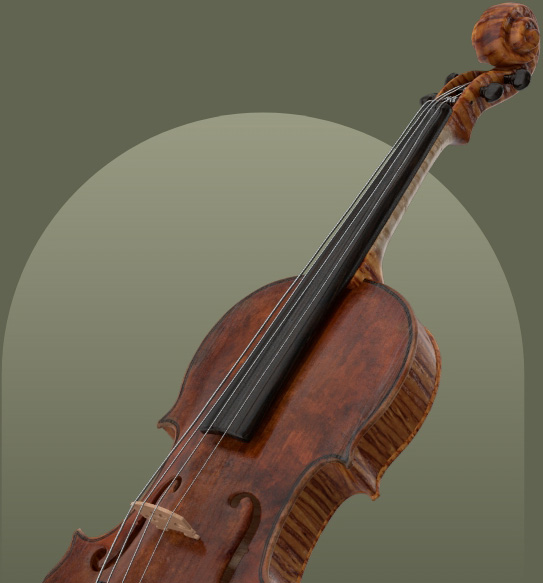
Johann (II) Padewet
Karlsruhe, 1850–1901
Johann (II) Padewet (born 1850 or 1851, died 1901 or 1902) was a German luthier, the son and pupil of Johann Padewet (I), who also apprenticed with A. Riechers in Hanover and Berlin. He succeeded his father's business and court appointment, becoming a prolific maker of violins, violas, violoncellos, and zithers, primarily on Stradivari models.
Known for his neat work and use of a fine golden-red oil varnish, he also applied theoretical knowledge of mathematical and acoustical laws to his craft. He was highly regarded as a repairer and restorer and received numerous awards at exhibitions in Karlsruhe, Mannheim, and Strasbourg.
Auction Price History
Highest auction price
| Type | Details | Auction house | Sold | Price |
|---|---|---|---|---|
| Cello | 1890 | — | November 1997 | £2,530 |
No results match those filters.
Maker Overview
Life
Johann (II) Padewet (born 1850 or 1851, died 1901 or 1902) was the son and pupil of Johann Padewet (I).
Sources contain conflicting information regarding his birth year, stating either 1850 or 1851, and his death year, stating either 1901 or 1902. He also apprenticed with A. Riechers in Hanover and Berlin.
He succeeded to his father's business and appointment to the court, with sources indicating this occurred in 1872, 1873, or after 1874. Johann (II) Padewet was a prolific maker, producing forty to fifty instruments annually with the assistance of two workmen.
He was also theoretically well-schooled, successfully striving to observe mathematical and acoustical laws in violin making. He was highly regarded as a repairer and restorer, with a great number of old instruments sent to him from all parts of the world.
Characteristics
- Models
- Johann (II) Padewet made instruments on Cremonese models, particularly the Stradivari pattern.
- Varnish
- He used a fine golden-red oil varnish, which he applied without prior staining of the wood, and notably, he kept the necks free from stain. For ordinary or poorer quality instruments, he also used spirit varnish.
- Instrument Types
- He made violins, violas, violoncellos, and also zithers.
- Workmanship
- His work was described as neat.
- Johann Padewet fecit
Karlsruhe anno 18..John Dilworth
Influence and legacy
- Mentorship: He was the son and pupil of Johann Padewet (I).
- Apprenticeship: He completed his training with A. Riechers (also referred to as Aug. Riechers) in Hanover and Berlin.
- Court Appointment: Like his father, he held the title of court instrument maker (Hofinstrumentenmacher).
- Awards: He received numerous awards, including prizes at Karlsruhe, Mannheim, and Strasbourg. Specific awards include a gold medal and diploma at Carlsruhe in 1877, a silver medal and diploma at Mannheim in 1880, and a gold medal and diploma of honour at Strassburg in 1895.
Further Information
- Workshop Location: His workshop was located at 132, Kaiserstrasse, Carlsruhe.
- Label: His instruments bear the inscription "Johann Padewet fecit / Karlsruhe anno 18.." and sometimes the initials "JP".
Biographies
The overview above is drawn from the following published accounts. Read them in the original:
John Dilworth+
PADEWET, JOHANN (II) Born 1850, died 1901 Karlsruhe Germany. Son and pupil of Johann Padewet (I). Also apprenticed to A. Riechers in Hanover. Succeeded to father’s business and appointment to the court in 1872. Prolific maker on Cremonese models. Neat work with fine golden-red oil varnish, although many instruments of poorer quality with spirit varnish retailed by him. Awarded prizes at Karlsruhe, Mannheim, and Strasbourg. Highly regarded repairer and restorer. Johann Padewet fecit / Karlsruhe anno 18.. JP
Willibald Leo Lütgendorff+
Sohn und Schüler von Joh. I. P. Seine Ausbildung schloss er bei Riechers
ab und machte sich 1873 als Nachfolger seines Vaters selbstständig. Er war
auch theoretisch gut geschult, so dass er die mathematischen und akustischen
Gesetze beim Geigenmachen zu beobachten sich mit Erfolg bestrebte. Er machte
Geigen aller Arten (auch Zithern etc.) vorzugsweise nach Stradivari und bediente
sich eines farbenschönen Öllacks, den er ohne vorheriges Beizen des
Holzes auftrug, auch die Hälse — bekanntlich ist es eine Unsitte vieler Geigenmacher, die Hälse zu beizen — hielt er davon frei. Bei gewöhnlichen Geigen verwendete er auch Spirituslack. Er war wie sein Vater Hofinstrumentenmacher und erhielt zahlreiche Auszeichnungen.
Cecie Stainer+
Son of Johann Padewet ; b Aug. 23, 1851, Carlsruhe. First a pupil of his father, then worked in Hanover and Berlin under Aug. Riechers till 1874.
Succeeded to his father’s business, at 132, Kaiserstrasse, Carlsruhe. Assisted by two workmen, he made forty to fifty instruments (violins, violas and violoncellos) a year, on the Stradivari pattern, using oil varnish, of reddish-yellow or golden-brown colour. He was especially skilful in repairing old instruments, of which a great number were sent to him from all parts of the world.
Awards : gold medal and diploma, Carlsruhe, 1877 ; silver medal and diploma, Mannheim, 1880 ; gold medal and diploma of honour, Strassburg, 1895.
He died 1902.
Sell your instrument with Amati
Get started by uploading photos of your instrument for our experts to review.
Sell your instrument with Amati
Get started by uploading photos of your instrument for our experts to review.