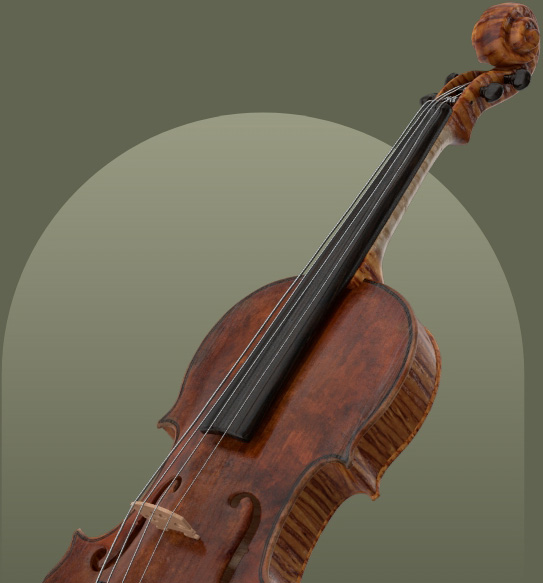
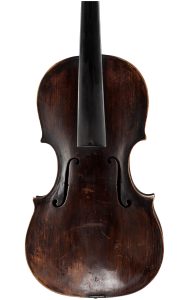
Peter (II) Wamsley
London, worked 1734–1751
Peter (II) Wamsley was an English instrument maker active in London from approximately 1734 to 1751, succeeding his father, Peter Wamsley (I). He gained a significant reputation, particularly for his violoncellos, and was known for copying the Stainer pattern and occasionally imitating Stradivari instruments. His work quality varied, with some instruments exhibiting fine tone, especially his violoncellos with thicker wood and his rare double-basses, while others suffered from excessive wood thinning. He often used ink lines instead of purfling and employed various labels, frequently his father's. Sources offer conflicting views on the long-term quality of his instruments, with some praising his skill and others noting the deterioration of tone over time due to his construction methods.
Request an expert valuation or learn how our global auctions achieve the highest prices for your instruments.
Auction Price History
Highest auction price
23 results
| Type | Details | Auction house | Sold | Price |
|---|---|---|---|---|
| Cello | 74.7 cm London, 1750 c. | — | June 2011 | £19,200 |
| Violin | 35.8 cm London, 1760 c. | — | June 2011 | £8,400 |
| Violin | 35.6 cm London, 1749 | — | March 2011 | £2,750 |
| Cello | 75.4 cm 1750 c. Attributed to | — | April 2010 | £5,754 |
| Cello | 74.6 cm London, 1740 c. | — | March 2009 | £8,125 |
| Violin | 35.6 cm London, 1750 c. Attributed to | — | June 2006 | £264 |
| Cello | London, 1740 c. | — | March 2005 | £2,400 |
| Cello | London, 1740 c. Possibly by | — | November 2004 | £10,800 |
| Violin | 1748 | — | May 2003 | £1,616 |
| Cello | 1740 | — | March 1999 | £4,500 |
| Cello | 1740 c. | — | June 1996 | £1,380 |
| Violin | 1747 | — | May 1995 | £345 |
| Violin | 1748 | — | December 1994 | £4,423 |
| Cello | 1735-50 | — | April 1993 | £2,314 |
| Cello | 1740 c. | — | March 1992 | £4,950 |
| Violin | 1749 | — | June 1991 | £2,860 |
| Violin | 1725-50 | — | November 1990 | £2,640 |
| Violin | 1738 | — | November 1990 | £880 |
| Violin | 1748 | — | March 1990 | £4,950 |
| Violin | 1738 | — | May 1989 | £792 |
| Violin | 1750 c. | — | November 1984 | £1,760 |
| Violin | 1740 c. | — | September 1983 | £2,200 |
| Violin | 1748 | — | April 1982 | £2,585 |
No results match those filters.
Maker Overview
Life
Peter (II) Wamsley (circa 1734-1751) was an English maker who worked in London., he was the son and successor of Peter Wamsley (I), becoming active in the workshop from approximately 1734. The business was subsequently passed to Thomas Smith in 1751. Cecie Stainer notes that he was active in London from about 1715 to 1751, and at one time, he held a great reputation, particularly for his violoncellos. Henri Poidras also places him in London around 1730. Willibald Leo Lütgendorff states that he initially operated under the sign 'at ye golden Harp' and later changed it to 'at the Harp and Hautboy'. Lütgendorff further mentions that Wamsley stood in high regard among his countrymen during his time, and the tone of his instruments was highly praised.
Characteristics
- Models
- Peter (II) Wamsley closely copied the Stainer pattern and also made a few imitations of Stradivari instruments., he primarily followed the Stainer model. Willibald Leo Lütgendorff notes that he imitated a type of Stainer model, but the proportions were incorrect, and the F-holes were very ugly.
- Workmanship
- His work varied significantly; some instruments were badly proportioned with ugly straight sound-holes and brownish-yellow varnish. Others were well made, featuring thick and brilliant red varnish. Cecie Stainer states that those with dark brown varnish are generally preferred. Vidal describes his lutherie as 'très médiocre' (very mediocre) overall.
- Materials & Technique
- In his attempts to achieve an Italian quality of tone, he sometimes thinned the wood too much, which resulted in a hollow sound. However, his violoncellos with thicker wood possess a fine tone. His double-basses are rare and generally feature red varnish. Instead of purfling, he commonly drew a line with ink, a detail also noted by Lütgendorff.
- Varnish
- His best varnish is described as dark red or reddish-brown, and instruments with darker varnish are considered more valuable.
- Instruments Made
- He made violoncellos, double-basses, and viols. Lütgendorff mentions that he made a few violins and violoncellos that do him credit.
Influence and legacy
- Family Lineage: He was the son and successor of Peter Wamsley (I), indicating a continuation of a family tradition in instrument making.
- Reputation: George Hart considered him one of the best English makers, and Cecie Stainer noted his great reputation, especially for his violoncellos. Willibald Leo Lütgendorff confirms that he was held in high esteem by his contemporaries.
- Conflicting Assessments: While praised by some, Vidal critically notes that his instruments, due to excessive thinning of the tops, have lost much over time, leading to his assessment of 'très médiocre' lutherie.
- Succession: The business was passed to Thomas Smith in 1751.
Biographies
The overview above is drawn from the following published accounts. Read them in the original:
John Dilworth+
WAMSLEY, Peter (II) Worked circa. 1734-1751 London UK. Son and successor of Peter Wamsley (I), above. Active in the workshop from c.1734, the business passing to Thomas Smith in 1751. Seems to have used his father’s label throughout his life. No instruments known with his individual signature or label. [BVMA]
Cecie Stainer+
A maker in London about 1715-51. He had at one time a great reputation, especially for his violoncellos. He copied the Stainer pattern very closely, and also made a few imitations of Stradivari instruments; but in his attempts to obtain an Italian quality of tone he thinned the wood too much, making the tone sound hollow. His violoncellos with thicker wood have a fine tone; so have his double-basses ; the latter are rare and generally have red varnish. His work varies, some instruments are badly proportioned, with ugly straight sound-holes and brownish-yellow varnish; others are well made, with thick and brilliant red varnish; but those with dark brown varnish are to be preferred ; they generally have ink lines instead of purfling. He also made viols. In a violoncello was the label “Made by Peter Wamsley at ye Golden Harp in Pickadilly London, 1727 ” , a similar label was dated 1733. Other labels are: “Made by Peter Wamsley at the Harp and Hautboy in Pickadilly, 1735 ‘ ; ” Made by Peter Wamsley at the Harp and Hautboy in Pickadilly, London, 1737” “Peter Wamsley, maker at he Harp and Hautboy in Picaddilly, 17 London 51”
William Meredith Morris+
The particulars given respecting this old maker in other books are, unfortunately, all that can be picked up from the dust of the past. I have nothing new to add, and therefore had better not say anything.
George Hart+
One of the best English makers. His copies of Stainer are very superior.
Willibald Leo Lütgendorff+
Ursprünglich führte er das Schild »at ye golden Harp« und vertauschte es später gegen »at the Harp and Hautboy«. Seiner Zeit stand er bei seinen Landsleuten in hohem Ansehen, und der Ton seiner Arbeiten wurde sehr gerühmt. Da er diesen aber nur durch ein meist übermässiges Ausschachteln der Decke erzielte, haben seine Geigen mit der Zeit sehr verloren. Er ahmte eine Art Stainer-Modell nach, die Verhältnisse sind jedoch unrichtig und die F-Löcher sehr hässlich. Statt der Einlage zog er gewöhnlich nur eine Linie mit Tinte, und Vidal sagt daher mit Recht: »En somme: lutherie très médiocre.« Am besten ist noch sein dunkelrother oder rothbrauner Lack, und die dunkler lackirten Geigen von ihm werden für werthvoller gehalten. Einige wenige Violinen und Violoncelli hat er aber doch gemacht, die ihm Ehre machen, aber doch kaum höher, als zu 350 M. verkauft werden können. Er verwendete verschiedene, meist gedruckte Zettel:
Henri Poidras+
London 1730. Stainer model. Red-brown varnish.
Sell your instrument with Amati
Get started by uploading photos of your instrument for our experts to review.
Sell your instrument with Amati
Get started by uploading photos of your instrument for our experts to review.