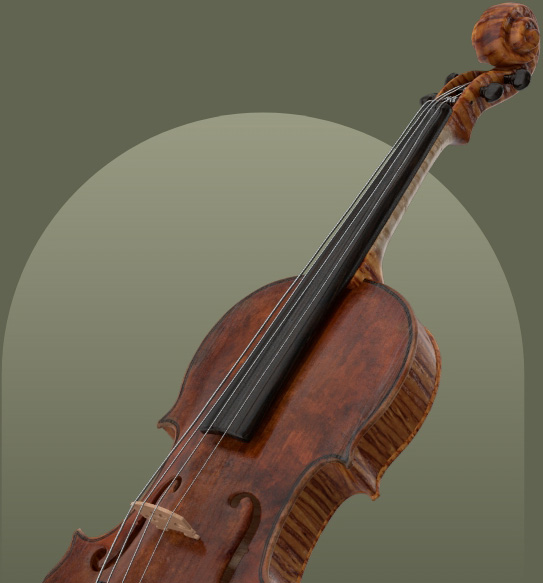
John King Monk
Merton, b. 1846
John King Monk (b. 1846) was a British violin maker known for his Stradivari-derived work, which incorporated his own modifications to outlines and F-holes. He received initial training from Batho and was self-taught through theoretical studies, crafting his first violin in 1886 based on Otto's principles. Monk utilized fine materials, including aged maple, sycamore, and pine from historical London structures, and applied his self-composed oil varnish. He is particularly noted for his innovative triple bass bar system, which he applied to instruments. He produced over ninety violins and some violas, settling in Merton and later Lewisham.
Auction Price History
Highest auction price
16 results
| Type | Details | Auction house | Sold | Price |
|---|---|---|---|---|
| Violin | Labelled Made by J.K. Monk, Lewisham, May 1910, No. 216, signed Lot 231 | Brompton’s | March 2021 | £720est. £ 400-600 |
| Violin | Two-piece back of broad curl, table of medium grain, varnish of a light brown colour on a golden ground Lot 2427 | Gardiner Houlgate | March 2020 | £324est. £ 300-400 |
| Violin | Labelled Made by J. K. Monk, Lewisham, l'an. 1910, No 91 Lot 335 | Brompton’s | June 2017 | £480est. £ 300-500 |
| Violin | Labelled J.R. Monk, Maker, Merton, Surrey, S.W., 10 May 1889 Lot 840 | Gardiner Houlgate | December 2014 | £384est. £ 150-200 |
| Violin | Labelled J. K. Monk, Melton, Surrey S.W., no. 46, 1893, signed on the label Lot 407 | Gardiner Houlgate | December 2012 | £432est. £ 300-400 |
| Violin | 1892 | — | February 2001 | £293 |
| Violin | 1898 | — | September 2000 | £747 |
| Violin | 1808 | — | May 1998 | £282 |
| Violin | 1899 | — | May 1995 | £518 |
| Violin | 1909 | — | May 1994 | £391 |
| Violin | 1903 | — | July 1992 | £242 |
| Violin | 1898 | — | July 1991 | £132 |
| Violin | 1894 | — | June 1990 | £154 |
| Violin | 1911 | — | June 1989 | £187 |
| Violin | 1912 | — | September 1988 | £176 |
| Violin | 1908 | — | March 1980 | £59 |
No results match those filters.
Maker Overview
Life
John King Monk (1846-Unknown) was born on January 22, 1846, in Merton, Surrey, UK. He was a direct descendant of General Monk, a figure of Commonwealth fame. In his youth, he received his initial instruction in violin making from Batho and further developed his skills independently through the study of theoretical works. In 1886, he crafted his first violin, basing it on the principles established by Otto. Monk initially settled in Merton S.W. before relocating to Lewisham S.E. His biography was published by Meredith-Morris in The Strad in 1899, No. 113.
Characteristics
- Model & Design
- Monk worked on the Stradivari model, though he slightly modified the outline, making the corners fuller and more prominent. He also considerably modified the sound-holes, which, while possessing character, led some to wish he had adhered more closely to the classical prototype. After initially imitating the Stradivari model, he later altered the outlines and F-holes according to his own calculations.
- Workmanship
- Sources describe his work as decent and Stradivari-derived. Willibald Leo Lütgendorff notes his workmanship as 'ungemein sauber und künstlerisch' (extremely clean and artistic), while William Meredith Morris suggests he was capable of better than he sometimes achieved.
- Materials
- He utilized various sorts of good quality wood. He sourced maple and sycamore slabs, some of which had aged for generations, from Shoreditch cabinet-makers' stores. The pine he used was obtained from an old warehouse at the foot of London Bridge, originally built in 1830, which was taken down in 1886-87. John Dilworth notes his use of fine materials.
- Varnish
- Monk employed an oil varnish of various colors, ranging from deep red to golden yellow or pale yellow to golden-red tint. It was perfectly transparent and fairly brilliant, and he composed it himself.
- Innovation
- He is credited as the inventor of the triple bar system, which he applied to worn-out old instruments and inexpensive modern factory fiddles. This system involves using three bass bars instead of the customary single one, placed in arithmetical progression under the bridge. John Dilworth mentions some of his output being 'afflicted by 'innovative' bass bar arrangements and other ideas.'
- Output
- He made ninety violins and a few violas, while Lütgendorff states he made over 100 violins and repaired numerous instruments. Dilworth characterizes his output as small.
- J. K. Monk Maker
Merton. Surrey S W
No.70 1889John Dilworth
Influence and legacy
- Mentorship: He received his initial instruction in violin making from Batho.
- Self-Study: Monk further developed his skills independently through the study of theoretical works.
- Foundational Principles: He made his first violin in 1886 based on the principles established by Otto.
Further Information
- Wood Usage: He utilized almost all the pine secured from the London Bridge warehouse, with the exception of some odd pieces and two small blocks sufficient for two bellies.
- Locations: He first settled in Merton S.W. and later moved to Lewisham S.E.
- Musical Compositions: Monk was also a skilled musician and composed a number of appealing musical pieces.
- Label Example: An example label reads: 'J. K. Monk Maker / Merton. Surrey S W / No.70 1889'.
Biographies
The overview above is drawn from the following published accounts. Read them in the original:
John Dilworth+
MONK, John King Born 1846 Merton, Surrey UK. Decent Stradivari-derived work. Small output, some afflicted by ‘innovative’ bass bar arrangements and other ideas. Fine materials with oil varnish of pale yellow to golden-red tint. J. K. Monk Maker / Merton. Surrey S W / No.70 1889
William Meredith Morris+
He was born Jan. 22, 1846, and is a direct descendant of General Monk, of Commonwealth fame. He works on the Stradivari model, but he has slightly modified the outline, making the corners fuller and more prominent. The sound-holes are considerably modified, and although they have much force of character and a piquancy all their own, yet one is constrained to wish that the maker had rest content with his classical prototype. In the matter of workmanship, this maker is capable of doing better than he sometimes does.
He has used sundry sorts of wood, all of good quality. He foraged Shoreditch cabinet-makers’ stores some years ago for material, and stumbled across several slabs of maple and one of sycamore, which had lain by for generations till it had got very dark. Some portions of this were very handsome when cut up. The pine which he has used up to the present was taken from an old warehouse at the foot of London Bridge, built in 1830. This same warehouse was removed to another part in i860, and in 1886-87 was taken down, when Mr. Monk took advantage of the opportunity of securing the wood that suited his purpose. He has used all this pine with the exception of some odd pieces, and two small blocks sufficient for two bellies.
His varnish is oil, and of various colours, ranging from deep red to golden yellow. It is perfectly transparent and fairly brilliant.
He is the inventor of the triple bar system, which he applies to worn-out old and to cheap modern factory fiddles. The system consists in the use of three bass bars instead of the usual one.
He has made up to date ninety violins and a few violas.
Willibald Leo Lütgendorff+
In seiner Jugend erhielt er die ersten Unterweisungen im Geigenmachen
von Batho und bildete sich durch das Studium theoretischer Werke selbstständig
weiter. Im Jahre 1886 machte er seine erste Geige nach den von Otto
aufgestellten Grundsätzen. Er ahmte zuerst das Stradivari-Modell nach, änderte
aber dann nach seinen eigenen Berechnungen die Umrisse und die F-Löcher.
Er hat seitdem über 100 Geigen gemacht, zahlreiche reparirt und arbeitet ungemein
sauber und künstlerisch. Er verwendet einen Öllack von verschiedener
Farbe, goldgelb bis dunkelroth, den er selbst zusammensetzt. Eine Eigenthümlichkeit
seiner Geigen ist ein dreifacher Bassbalken, der in arithmetischer Progression
unter dem Steg angebracht ist. Er ist auch ein geschickter Musiker
und hat eine Reihe sehr ansprechender Musikstücke componirt. Er liess sich zuerst
in Merton S. W. nieder und siedelte dann nach Lewisham S. E. über. Seine Biographie
veröffentlichte Meredith – Morris in »„he Strad« 1899 No. 113.
Sell your instrument with Amati
Get started by uploading photos of your instrument for our experts to review.
Sell your instrument with Amati
Get started by uploading photos of your instrument for our experts to review.