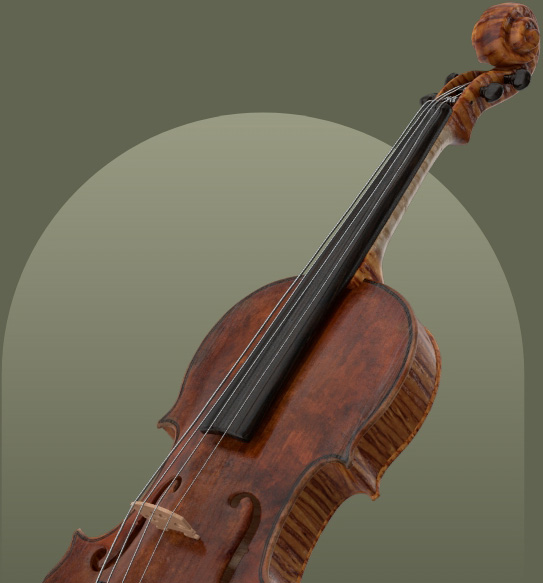
Arthur Bowler
Thame, b. 1867
Arthur Bowler (1867-Unknown) was a British violin maker born in Thame, Oxfordshire, and the nephew of George Chanot.
Initially trained as a joiner, he apprenticed with J. A. Chanot in London from 1895 to 1899, becoming his principal assistant.
In 1899, he established his own workshop in Islington, focusing on repair and restoration while also producing around 40 violins and at least one cello.
His instruments, often based on the Stradivari 'Messie' model, are noted for their accurate observation, excellent finish, beautiful wood, and clear tone, often featuring a dark orange-red amber varnish.
Request an expert valuation or learn how our global auctions achieve the highest prices for your instruments.
Auction Price History
Highest auction price
8 results
| Type | Details | Auction house | Sold | Price |
|---|---|---|---|---|
| Violin | Labelled Arthur Bowler, London, Fecit 1904, A.B. Lot 100 | Brompton’s | October 2016 | £3,000est. £ 1,000-1,500 |
| Viola | Labelled Arthur Bowler, London, Fecit 1903 Lot 134 | Brompton’s | March 2015 | £6,000est. £ 6,000-10,000 |
| Violin Bow | 35.9 cm London, 1903 | — | June 2008 | £4,200 |
| Violin | 1900 | — | May 2003 | £1,909 |
| Violin | 1903 | — | May 2003 | £1,102 |
| Violin | 1904 | — | October 1995 | £2,185 |
| Violin | 1900 | — | March 1995 | £2,990 |
| Cello | 1901 | — | October 1993 | £4,400 |
No results match those filters.
Maker Overview
Life
Arthur Bowler (1867-Unknown) was born on July 12, 1867, in Thame, Oxfordshire, UK, as detailed by William Meredith Morris in British Violin Makers and John Dilworth in The Brompton's Book of Violin & Bow Makers.
He was the nephew of George Chanot on his mother's side, a relationship that in Die Geigen- und Lautenmacher vom Mittelalter bis zur Gegenwart, sparked his interest in violin making from an early age.
Initially, Bowler trained as a joiner in his grandfather's workshop, a skill that proved very useful later.
He moved to London in 1895 and, after the death of his uncle Chanot, offered his services to J. A. Chanot, his uncle's son and successor.
He was apprenticed to J. A. Chanot in Wardour Street from 1895 to 1899, quickly becoming his principal assistant due to his prior woodworking knowledge.
In 1899, Arthur Bowler established his own shop in Islington.
Characteristics
- Work
- Arthur Bowler was chiefly occupied with repair and restoration work, but he also made approximately 40 violins and at least one cello.
- Models
- His violins were mostly made on the Stradivari 'Messie' violin model, with others in the Guarneri style.
- Quality
- His instruments are described as 'accurately observed and very well finished' by Dilworth, and William Meredith Morris noted that he 'turns out excellent instruments' with 'beautiful wood and varnish' and a 'firm, round, and clear' tone.
- Varnish
- Lütgendorff mentions that Bowler used a dark orange-red amber varnish (dunkel-orange-rothen Bernsteinlack).
- Workmanship
- Lütgendorff also highlights his exceptionally clean workmanship (arbeitet ungemein sauber).
- Arthur Bowler AB
London. Fecit, 1900John Dilworth
Influence and legacy
- Family Connection: Arthur Bowler was the nephew of George Chanot, a relationship that, fostered his early interest in violin making.
- Early Training: He initially trained as a joiner in his grandfather's workshop, a skill that greatly benefited his later work in violin making.
- Apprenticeship: He was apprenticed to J. A. Chanot in Wardour Street from 1895 to 1899, where he became the principal assistant, as detailed by John Dilworth and William Meredith Morris.
- Recognition: William Meredith Morris, in British Violin Makers, predicted that 'The work of this maker is bound to come to the front in the near future.'
- Publications: A biography of Arthur Bowler, including a portrait, violin illustration, and label, was published by Rev. Meredith-Morris in The Strad (April 1900, No. 120).
Further Information
- Workshop Location: After establishing his own business in 1899, Arthur Bowler worked at 18 Milner Square, Islington, as stated by William Meredith Morris.
- Label: His instruments bear a facsimile label that reads 'Arthur Bowler AB / London. Fecit, 1900', according to John Dilworth.
Biographies
The overview above is drawn from the following published accounts. Read them in the original:
John Dilworth+
BOWLER, Arthur Born 1867 Thame, Oxfordshire UK. Nephew of George Chanot. Trained as a joiner, later apprenticed to J. A. Chanot in Wardour Street, 1895-1899, becoming his principal assistant. Established his own shop in Islington 1899. Chiefly occupied with repair and restoration work, but some 40 violins made, mostly on the Stradivari ‘Messie’ violin model; others in Guarneri style, and at least one cello, all accurately observed and very well finished. Arthur Bowler AB / London. Fecit, 1900
William Meredith Morris+
He works at 18 Milner Square, Islington, and was born July 12, 1867, at Thame, Oxfordshire. He is a nephew on his mother’s side to the late Georges Chanot. He worked with Mr. J. A. Chanot for some time, where he got on so well that he became principal workman to that firm. In 1899 he started business on his own account, and he turns out excellent instruments, on the Stradivari model. The wood and varnish are beautiful, and the tone is firm, round, and clear. The work of this maker is bound to come to the front in the near future. Facsimile label : —
Willibald Leo Lütgendorff+
Seine Mutter war die jüngste Schwester der Frau von Georges Chanot, so
dass schon in früher Jugend sein Interesse für den Geigenbau geweckt wurde;
doch erlernte er zunächst in der Werkstatt seines Grossvaters die Schreinerei.
1895 nach London gekommen, suchte er seinen Oheim Chanot auf und bot nach dem Tode desselben dem Sohne und Nachfolger seine Dienste an. I. A. Chanot
nahm ihn auf drei Jahre in die Lehre. Hier kamen ihm seine Vorkenntnisse
in der Holzbearbeitung sehr zu Statten, und er machte schnelle Fortschritte. Er
blieb bei Chanot bis 1899 und machte sich dann selbstständig. Bowler arbeitet
ungemein sauber und baut seine Geigen hauptsächlich nach der »Messias« von
Stradivari. Er verwendet einen dunkel-orange-rothen Bernsteinlack und wird als
Künstler geschätzt. Seine Biographie mit Bildniss, Geigenabbildung und Zettel
veröffentlichte Rev. Meredith-Morris in »The Strad« (April 1900, No. 120).
Sell your instrument with Amati
Get started by uploading photos of your instrument for our experts to review.
Sell your instrument with Amati
Get started by uploading photos of your instrument for our experts to review.