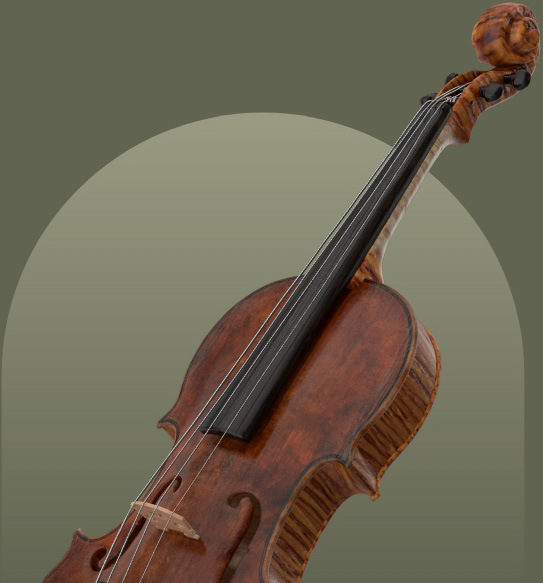
Joseph Rook
Carlisle, 1777–1852
Request an expert valuation or learn how our global auctions achieve the highest prices for your instruments.
Auction Price History
Highest auction price
4 results
| Type | Details | Auction house | Sold | Price |
|---|---|---|---|---|
| Violin | Two-piece back of faint medium curl, varnish of a reddish brown colour on a golden ground Lot 24 | Gardiner Houlgate | March 2012 | £3,600est. £ 900-1.200 |
| Violin | 1830 c. | — | August 1993 | £462 |
| Violin | 1850 c. | — | September 1991 | £935 |
| Violin | 1807-52 | — | November 1986 | £176 |
No results match those filters.
Biographies
The overview above is drawn from the following published accounts. Read them in the original:
John Dilworth+
ROOK, Joseph Born 1777 Caldbeck, died 1852 Carlisle UK. Pupil of Joseph Scott. Employed by him as a farm labourer and instrument maker at his farm Haltcliff, Eskett, near Caldbeck 1795-1800. Became chorister at Carlisle Cathedral in 1800 and choir master from 1807. Contributed to Sandys & Forster History of the Violin’ (London, 1864) in which he states ‘I have made 12 tenors and 5 violoncellos; no double basses. I marked my name with a small stamp ‘J.Rook/ Carlisle’. I generally wrote my name in the inside of the bellies with a black lead pencil’. Forster however mentions violins made by him. Cello cited in Hill Archive: ‘work and style fair but amateurish. Materials good. Crude outline; prominent rounded edges; blunt corners and exaggerated Stainer ‘f’s, placed too high. Varnish light golden brown.’ Small 28 ½” (72.4cm) cello model. Inscribed internally: J.Rook / Carlisle 1816 [Hill Archive, Sandys & Forster, BVMA]
Cecie Stainer+
A maker in London about 1777 to 1830. His instruments show good work and follow the pattern of Forster.
William Meredith Morris+
He made fairly good copies of Stainer and Amati, on the Forster lines. The tone in some instances was very good.
Willibald Leo Lütgendorff+
Vielleicht ein Schüler der Forster, an deren Arbeit seine Geigen erinnern.
Henri Poidras+
London Circa 1780. Work after the Forster manner.
Sell your instrument with Amati
Get started by uploading photos of your instrument for our experts to review.
Sell your instrument with Amati
Get started by uploading photos of your instrument for our experts to review.