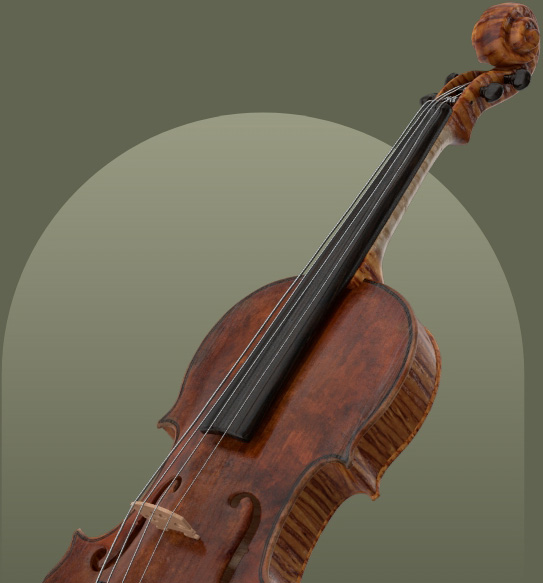
Antonio Amati
Cremona, d. 1607
Antonio Amati, the elder son and pupil of Andrea Amati, was a significant Cremonese luthier active from at least 1559. He worked extensively with his younger brother Hieronymus, and their instruments, often referred to as 'the Brothers Amati', were highly regarded, particularly in France, where they supplied instruments to the royal court. While early works resembled his father's style, later instruments featured a less high arching and neat finish, with a sweet, though not powerful, tone. There are conflicting accounts regarding his exact birth and death dates, with sources suggesting his lifespan ended in 1607 or extended as late as 1648. He sold his business interest to Hieronymus in 1588 but may have continued making plucked instruments, and his works are noted for their excellent preservation.
Auction Price History
Highest auction price
| Type | Details | Auction house | Sold | Price |
|---|---|---|---|---|
| Violin | 1588 | — | March 1991 | £44,000 |
No results match those filters.
Maker Overview
Life
Antonio Amati (Born before 1540, died 1607 or later) Antonio Amati, the elder son and pupil of Andrea Amati, was born before 1540 in Cremona, Italy. John Dilworth, in The Brompton’s Book of Violin & Bow Makers, states this birth year and reports his death in 1607. However, Cecie Stainer, in A Dictionary of Violin Makers, suggests a birth in Cremona around 1560 and mentions a label found in a violin indicating he was still living in 1648. He was already recorded as a luthier in 1559 and assisted his father with aristocratic commissions during the 1560s and 1570s (Dilworth).
After his father Andrea's death in 1577, Antonio continued working with his younger brother Hieronymus (also referred to as Girolamo). This partnership is well-documented by Dilworth, Stainer, and Willibald Leo Lütgendorff in Die Geigen- und Lautenmacher vom Mittelalter bis zum Gegenwart. They are often collectively known in English as ‘the Brothers Amati’ (Dilworth). Like their father, the Amati brothers built magnificently decorated violins for the French royal court (Lütgendorff). Although they mostly worked together, a very few instruments exist that are individually labelled by either brother (Dilworth).
Antonio sold his interest in the family business to Hieronymus in 1588 (Dilworth). At the time of his death in 1607 (per Dilworth), he was still officially described as ‘Antonio de li Liuti’, suggesting he may have continued in the profession, possibly as a maker of plucked instruments (Dilworth). While Dilworth indicates his death in 1607, Stainer notes instruments documented from 1589, including several violins dated from 1591 to 1619 listed in a 1791 catalogue belonging to Albinoni of Milan, which aligns with Stainer's suggestion of a later lifespan.
Characteristics
- Methods
- Antonio Amati's instrument pattern resembled that of his father, though it was less highly arched. Willibald Leo Lütgendorff confirms that the brothers' later and better violins had a less high arching compared to their initial works, which resembled their father's style. Stainer notes that the sound-holes retained the Brescian type, and the workmanship displayed a neat finish. Lütgendorff describes the varnish as initially thicker and dark (cherry brown), later becoming thinner and acquiring a beautiful orange color. While high arching provides greater elasticity and resistance to string pressure, allowing for thinner construction of plates, a flatter top yields a larger and nobler tone. Instruments labeled 'the Brothers Amati' often presented attribution challenges, leading to the presumption that their individual work could be distinguished, with the better ones frequently attributed to the more talented Hieronymus.
Influence and legacy
- Training and Mentorship: He was the pupil of his father, Andrea Amati (Dilworth).
- Notable Associations: The Amati brothers were highly valued in France and built instruments for the French royal court (Lütgendorff).
- Modern Recognition: While individual instruments solely attributed to Antonio Amati are rare, the works of 'the Brothers Amati' are mostly excellently preserved. This quality can perhaps be attributed to features like their arching, which, even when less high than earlier models, still contributed to structural integrity (Lütgendorff).
Biographies
The overview above is drawn from the following published accounts. Read them in the original:
John Dilworth+
AMATI, Antonio Born before 1540, died 1607 Cremona Italy. Eldest son and pupil of Andrea. He and another son Hieronymus, below, are often referred to in English as ‘the Brothers Amati’. Already recorded as a luthier in 1559, he undoubtedly assisted his father in the aristocratic commissions of the 1560s and 70s. After Andrea’s death in 1577 he continued working with his younger brother Hieronymus, although a very few instruments individually labelled by the brothers do exist. He sold his interest in the business to Hieronymus in 1588, but at his death was still described in official documents as ‘Antonio de li Liuti’ and may therefore have continued in the profession, possibly as a maker of plucked instruments.
Willibald Leo Lütgendorff+
Ältester Sohn von Andrea A. Er arbeitete viele Jahre gemeinsam mit seinem Bruder Hieronymus. Ihre stets trefflichen Instrumente erinnern anfangs noch an die Arbeiten des Vaters. Ihre späteren und besseren Geigen haben eine weniger hohe Wölbung. Die verschiedenen, mit dem gemeinsamen Zettel bezeichneten Instrumente stimmen nur selten miteinander überein, so dass man die Arbeit der Brüder unterscheiden zu können vermeint; die besseren werden dem talentvolleren Hieronymus zugeschrieben. Der Lack ist anfangs dicker und dunkel (kirschbraun) und wird später dünner und hat schone Orangefarbe. Nach dem Tode seines Bruders zeichnete er seine Arbeiten nur mit seinem Namen. Die Brüder haben nicht allzu viel Werke hinterlassen, ihre Geigen sind aber meist vorzüglich erhalten, was man vielleicht der immerhin noch hohen Wölbung zuschreiben kann. Eine Decke mit hoher Wölbung besitzt grössere Elasticität und vor allem grösseren Widerstand gegen den Saitendruck, obwohl sie dünner ausgearbeitet werden kann. (In der Brust liessen die Bruder Amati das Holz in der Regel 20mm dick.) Freilich hat eine Violine mit flacher Decke einen grösseren und wohl auch edleren Ton. Die Brüder waren, wie ihr Vater, weit über ihr Vaterland hinaus berühmt und wurden namentlich in Frankreich hochgeschätzt. Auch sie bauten prächtig ausgestattete Geigen für den französischen Königshof.
Cecie Stainer+
Elder son of Andrea Amati, b. Cremona about 1560 ; was still living in 1648, according to a label found in a violin. Was in partnership with his brother Girolamo. His instruments date from 1589, and are generally small size; several violins dated from 1591 till 1619 were in a catalogue, published 1791, of the instruments of Albinoni of Milan. The pattern resembles that of his father, but is not so arched, the sound-holes retain the Brescian type, the work shows neat finish, the tone is sweet but not powerful.
Sell your instrument with Amati
Get started by uploading photos of your instrument for our experts to review.
Sell your instrument with Amati
Get started by uploading photos of your instrument for our experts to review.