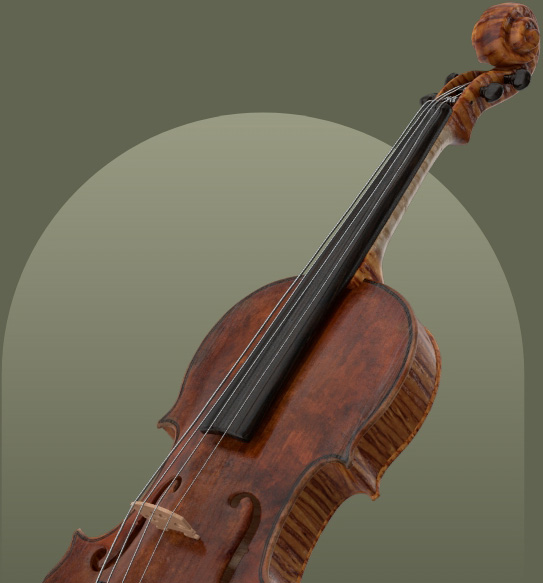
Girolamo (Hieronymus) (I) Amati
Cremona, 1561–1631
Girolamo (Hieronymus) (I) Amati (born 1561/1562, died 1630/1631) was a significant figure in the Cremonese violin-making tradition, being the younger son of Andrea Amati and the father of the celebrated Nicola Amati. Based in Cremona, he played a crucial role in establishing the city's reputation as a center for violin making during a period when the Amati shop was the sole source of instruments there. Girolamo collaborated with his brother Antonio, and their joint work marked a notable evolution in instrument design, introducing features such as raised arches, broadened soundhole wings, and the hollowing of the top to achieve a sweeter tone. Girolamo is also credited with pioneering the design of contralto violas with reduced dimensions, foreshadowing modern viola forms. His instruments, whether crafted individually or jointly with his brother, are recognized for their powerful tone, meticulous craftsmanship, and characteristic varnish applications and wood preparation, including two-piece backs with reversed flame patterns. While historical accounts present some conflicting dates regarding his death, the end of his collaboration with Antonio, and his first wife's passing, his legacy as an innovator and master luthier, whose instruments included a violin for Henri IV. of France, is firmly established.
Request an expert valuation or learn how our global auctions achieve the highest prices for your instruments.
Auction Price History
Highest auction price
36 results
| Type | Details | Auction house | Sold | Price |
|---|---|---|---|---|
| Violin | 35.3 cm (head probably Cremona, late 17th C.) | — | November 2011 | £280,179 |
| Violin | 35.1 cm Cremone 1625-1630 c. (table, head and some ribs replaced) | — | June 2011 | £69,435 |
| Violin | 35.5 cm Cremona, 1611 (Italian scroll possibly by another hand) | — | December 2010 | £156,000 |
| Violin | 34.3 cm Cremona, 1619 c. | — | October 2010 | £69,698 |
| Violin | 34.1 cm Cremona, 1618 | — | March 2008 | £42,500 |
| Violin | Ascribed to | — | February 2005 | £4,800 |
| Violin | Cremona, 1630 c. | — | October 2004 | £21,249 |
| Violin | 1630 (poor condition, scroll replaced) | — | December 2003 | £30,923 |
| Violin | 1608 | — | November 2000 | £75,594 |
| Viola | 42.4 cm 1616 | — | May 2000 | £517,000 |
| Violin | 1623 | — | March 1999 | £87,300 |
| Violin | 1620 c. | — | March 1998 | £56,500 |
| Violin | 1620 c. | — | June 1994 | £56,500 |
| Violin | 1624 | — | April 1993 | £18,400 |
| Violin | 1588 7/8 Size | — | March 1992 | £55,000 |
| Violin | 1621 | — | November 1991 | £88,000 |
| Violin | 16-- | — | November 1991 | £29,700 |
| Violin | 1623 | — | November 1990 | £25,300 |
| Violin | 1631 (table by "Ferdinand Galiano") | — | November 1990 | £25,300 |
| Violin | 1611 | — | November 1989 | £28,600 |
| Violin | 1693 | — | November 1989 | £68,200 |
| Violin | 1624 | — | June 1989 | £28,600 |
| Violin | 1596 | — | March 1989 | £12,100 |
| Violin | 1625 c. | — | June 1988 | £19,800 |
| Cello | 1680-99 | — | June 1988 | £99,000 |
| Violin | 1596 | — | March 1988 | £31,000 |
| Violin | 1635 | — | November 1987 | £23,100 |
| Violin | 1691 | — | November 1986 | £22,000 |
| Cello | 1624 | — | May 1986 | £59,400 |
| Violin | 1625 c. | — | May 1986 | £28,600 |
| Violin | 1580-99 | — | November 1985 | £16,500 |
| Violin | 1693 | — | July 1985 | £39,600 |
| Violin | 1626 | — | June 1984 | £16,296 |
| Violin | 1634 7/8 Size | — | February 1982 | £6,541 |
| Violin | 16-- | — | November 1981 | £4,620 |
| Violin | 1609 | — | November 1980 | £5,500 |
No results match those filters.
Maker Overview
Life
Girolamo (Hieronymus) (I) Amati (b. 1561/1562, d. 1630/1631) Girolamo Amati, also known as Hieronymus (I), was born in 1561 in "The Brompton’s Book of Violin & Bow Makers," or about 1562 in "A Dictionary of Violin Makers." He died in 1631, though Stainer specifies November 2, 1630, and Willibald Leo Lütgendorff in "Die Geigen- und Lautenmacher vom Mittelalter bis zum Gegenwart" also indicates 1630 as his year of death. He was the younger (Dilworth, Lütgendorff) or second (Stainer) son of Andrea Amati, based in Cremona, Italy. Girolamo first married Ippolita Zucchielli around 1576, with whom he had five daughters. Sources conflict on Ippolita's death year, with Stainer indicating 1583, while Lütgendorff states October 27, 1630. Lütgendorff's latter date is inconsistent with Girolamo's remarriage in 1584. On May 24, 1584, Girolamo married Laura Lazzarini, and they had nine children; their fifth child, Nicola Amati, would become the most celebrated maker in the family. was "significantly more talented and original than his brother and, like him, more important than their father."
Girolamo worked with his brother Antonio; however, sources provide conflicting accounts regarding the duration of their collaboration. Dilworth notes that Hieronymus continued to use the ‘brothers’ formula ‘Fr.[atelli] Amati’ on his labels even after Antonio's departure in 1588. Lütgendorff suggests it is "not probable" that the brothers separated in their last years, citing the existence of violins with joint labels from 1630. In contrast, Stainer states they worked together until 1628, though she also indicates Girolamo worked independently from as early as 1624, presenting a discrepancy in the timeline. From about 1610, Girolamo was assisted by his son Nicola. Production at the Amati shop increased markedly during this period, and the city of Cremona became widely recognized for its violins, as the Amati shop was the sole source in the city. Girolamo was a victim of the plague that swept northern Italy in 1630.
Characteristics
- Innovation
- From 1615, Girolamo Amati began creating a small number of contralto violas with radically reduced dimensions compared to the large tenors of the previous century, thus anticipating the modern viola design. He and his brother also initiated the process of raising the arch and broadening the lower wing of the soundholes., they introduced the hollowing of the top on both sides of the bridge, which made the sound "sweeter and more lovely." Stainer notes that the brothers produced instruments in what became known as the “Amati style.”
- Materials
- The wood used for their instruments was generally maple for backs and sides, and spruce or fir for the tops. A distinctive feature of their two-piece backs is that one side was often reversed, creating the illusion of continuous flame across the joint rather than a mirrored reflection. A historically significant 1595 violin for Henri IV. of France featured tortoiseshell purfling.
- Methods
- Instruments made by Girolamo, either alone or with his brother, are generally few in number but are often found in good preservation. They typically feature a small size (with the back often in one piece), accurate proportions, a slight arch towards the middle, and strongly marked grooves at the sides. Their scrolls varied, often being richly worked, and the corners and purfling were carefully executed, with the edges just overlapping the sides. The varnish on earlier instruments was deeper in color (possibly due to age), while later examples featured an orange color, thinly applied, which distinctly highlighted the wood grain. A 1595 violin is described as having brilliant amber oil varnish. When Girolamo worked alone after 1624, his finest instruments were large violins, characterized by a significant arch, broad purfling, a well-crafted scroll, and a yellow-brown varnish; however, the fourth string on these instruments was sometimes noted as not being equal to the others. The distinctive form of fluting at the front face of the scroll, first used by Andrea Amati, continued in Girolamo's work.
- Antonius et Hieronymus Fr. Amati
Cremonen Andrea fil F.15..John Dilworth
Influence and legacy
- Training and Mentorship: Girolamo was assisted by his son Nicola from about 1610. His fifth child, Nicola Amati, became the most celebrated maker in the Amati family.
- Schools/Tradition: During Girolamo Amati's active period, the Amati shop was the exclusive source of violins in Cremona, leading the city to become synonymous with the instrument throughout Europe. The works of Antonio and Hieronymus are often considered together, representing a visible advancement over their predecessors.
- Notable Associations: A violin signed by Antonio and Hieronymus Fr. Amati and dated 1595 holds historical value as it belonged to Henri IV. of France.
- Famous Owners: Among his historically significant instruments, a violin signed by the brothers and dated 1595 is known to have been owned by Henri IV. of France.
Further Information
- Technical Characteristics: Cellos bearing the brothers’ label are consistently of a large size, although many have been reduced in later years. The tone of instruments made by Girolamo and his brother was considerably more powerful than those by Andrea Amati. Their labels often included phrases such as "Antonius et Hieronymus Fr. Amati / Cremonen Andrea fil F.15.." and "Antonius et Hieronymus Amatus, Cremonen, Andreae fil. F. 1592."
- Historical Uncertainties: Sources present conflicting information regarding Girolamo Amati's death year, with John Dilworth stating 1631, while Cecie Stainer and Willibald Leo Lütgendorff both indicate 1630. There is also disagreement concerning the duration of his collaboration with his brother Antonio; Dilworth suggests Hieronymus continued to use joint labels after Antonio's 1588 departure, and Lütgendorff deems a separation unlikely given joint labels from 1630, whereas Stainer states they worked together until 1628, with Girolamo working alone after 1624. Furthermore, the death year of his first wife, Ippolita Zucchielli, is contested, with Lütgendorff reporting October 27, 1630, and Stainer 1583; Lütgendorff's date is likely erroneous given Girolamo's remarriage in 1584. Lütgendorff identifies a label with the name "Hieronimus (sic) Amati" and the year 1640, published by Grillet, as a forgery.
Biographies
The overview above is drawn from the following published accounts. Read them in the original:
John Dilworth+
AMATI, Hieronymus (I) Born 1561, died 1631 Cremona Italy. Younger son of Andrea Amati, above. After the departure of his brother Antonio in 1588, Hieronymus continued to use the ‘brothers’ formula ‘Fr.[atelli] Amati’ on his labels. Production increased markedly and the city of Cremona quickly became synonymous with the violin throughout Europe in the period when the Amati shop was the only source of violins in the city. From about 1610 he would have been assisted by his son Nicolò in meeting the burgeoning demand. Hieronymus, like Maggini in Brescia, was a victim of the plague which swept northern Italy in 1630. From 1615 he began making a small number of contralto violas which were radically reduced in dimensions compared to the large tenors made in the previous century. Their design and scale anticipated the modern viola. Cellos bearing the brothers’ label are invariably of large size, although most have been reduced in later years. In stylistic terms the brothers began to the process of raising the arch and broadening the lower wing of the soundholes. The distinctive form of fluting at the front face of the scroll used by Andrea continued. Many instruments made with two-piece backs have one side reversed so that the flame appears to continue across the joint rather than reflected mirror-fashion. Painted and decorated examples are exceedingly rare in contrast to the work attributed to Andrea, and presumably reflects the developing market among professional musicians requiring instruments in this period. Viols of violin form and other hybrid instruments also exist. Antonius et Hieronymus Fr. Amati / Cremonen Andrea fil F.15..
Willibald Leo Lütgendorff+
Jüngerer Sohn von Andrea A. In erster Ehe (um 1576) vermählt mit
Ippolita Zucchielli (f 27. Oct. 1630), von welcher er fünf Töchter hatte. Am
24. Mai 1584 ging er mit Laura Lazzarini eine zweite Ehe ein, von der er
neun Kinder bekam; das fünfte davon war Nicola. Hieronymus war ungleich
talentvoller und origineller als sein Bruder und wie dieser bedeutender als der
Vater. Er arbeitete mit seinem Bruder gemeinsam. Dass sich in den letzten
Lebensjahren die Brüder getrennt haben sollen, ist nicht wahrscheinlich, da
es noch Violinen mit gemeinsamem Zettel und der Jahreszahl 1630, also dem
Todesjahr Girolamo’s, giebt. Ein von Grillet veröffentlichter Zettel mit dem
Namen »Hieronimus (sic) Amati« tragt die Jahreszahl 1640 und erweist sich
dadurch als Fälschung. Wenn man auch mehrfach versucht hat, die Arbeiten der beiden Brüder auseinanderzuhalten, so können sie doch nur gemeinsam beurtheilt werden. Alles an ihren Geigen verdient Lob, und ihre Arbeit weist in allen Einzelheiten einen sichtbaren Fortschritt gegen ihre Vorgänger auf. Sie führten auch die Aushöhlung der Decke zu beiden Seiten des Stegs ein, wodurch der Ton süsser und lieblicher wurde. Die Formen ihrer F-Löcher und der Ecken zeigen die folgenden Abbildungen.
Cecie Stainer+
Second son of Andrea Amati, b. about 1562; d. Nov. 2, 1630. Worked with his brother Antonio till 1628. The earliest reliable date in connection with them is 1577. They produced the first form of the instrument known as “Amatise.” The pattern first followed, similar to that of Andrea, was more arched than that used later. Their instruments are few in number, but in good preservation, generally small size (the back often in one piece), of accurate proportions, slightly arched towards the middle, with strongly marked grooves at the sides ; the scrolls vary, often richly worked, the corners and the purfling are carefully done, the edges just overlap the sides; the wood generally maple or deal ; the varnish, deeper in colour on the earlier instruments (possibly owing to old age), is later of an orange colour, thinly laid on, and throws up the grain of the wood very distinctly. The tone is far more powerful than in Andrea’s instruments. A violin signed by them and dated 1595, which belonged to Henri IV. of France, is of historical value. It is made on a large pattern, the oil varnish a brilliant amber colour, the purfling of tortoiseshell, and on the back are painted the royal arms of France and Navarre, &c.
a similar one in a viola dated 1620 : ” Antonius et Hieronymus Amatus, Cremonen, Andreae fil. F. 1592 ” ;
a similar one dated 1624.
After 1624, Girolamo worked alone, making both large and small violins ; the former were the finest instruments, much arched, with broad purfling, good scroll, and varnish yellow-brown colour; beautiful tone, but the fourth string was not equal to the others.
Girolamo married first Ippolita Zuchielli (d. 1583), then Laura Lazzarini on May 24, 1584; she had nine children, the fifth child being Nicola, who became the most celebrated maker in the family.
Sell your instrument with Amati
Get started by uploading photos of your instrument for our experts to review.
Sell your instrument with Amati
Get started by uploading photos of your instrument for our experts to review.